Luxury vinyl is a type of flooring that has gained popularity among homeowners seeking affordable, decorative, and durable floors. However, LVT and LVP are based on different types, and it could affect their respective processing and placement. LVT flooring installation knowledge would enable homeowners to learn the process, which is as cumbersome as the installation of luxurious vinyl plank. There are also no big differences in the constructions of both materials on the catalogue; however, tile-like forms may need more guidelines on layout, placement, and chiselling. At Sunset Hardwood Floors and Remodeling, professional installations of floors could be applied in the development of the final product to ensure it is correct and durable.
What Is LVT Flooring Installation?
LVT flooring installation is the covering of luxury vinyl floors that resemble the appearance of stones such as natural stone, ceramic, or porcelain. LVT primarily comes in either a square or a rectangular shape and therefore gives homeowners the liberty to come up with different patterns in floors.
Depending on the product, LVT can use either click-lock or glue-down systems of installation. The subfloor should be dry, clean, and level, and it should be prepared before installation. This is particularly important with tile patterns, where precise measurements and positioning are essential.
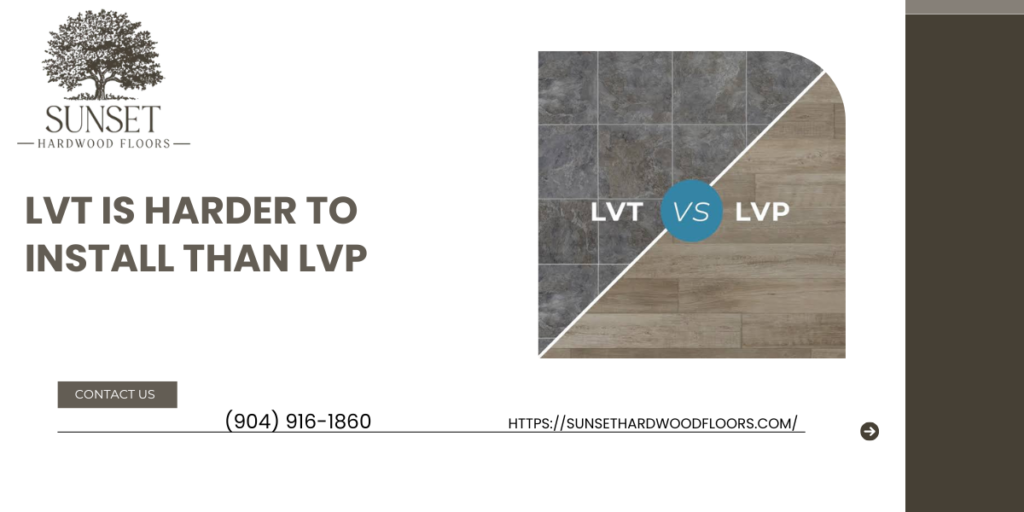
Is LVT Harder to Install Than LVP?
All in all, neither material is significantly more challenging to install, especially using the current click-lock systems. However, a few more difficulties might be connected with the layout in the case of installing luxury vinyl tiles, as the individual tiles have to be identical all around the room.
The planks of LVP are long, with staggered rows normally installed. This may contribute towards the accomplishment of a routine pattern. Rather, LVT may require the finer tuning of straight grout line construction or geometrical forms.
The complexity is in the eventual product, shape of the room, condition of the subfloor, and the method of installation taken.
Comparing LVP Flooring Installation
LVP flooring installation can be deemed relatively simple since the planks can be laid in staggered rows and a number of products are interlocked through the click-lock system. The plank shape also comes in longer planks and will provide the ability to build a continuous resembling of wood in bigger rooms.
However, even with proper installation, it is a poorly thought-out preparation. Planks can be required to be cut around door frames, corners, and cabinets as well as other obstructions. Also important to the performance in the long term are the right expansion gaps and the provision of sufficient connections between the planks.
Uneven seams, movement, and premature wear can be avoided with the assistance of professional installation.
Luxury Vinyl Tile vs. Luxury Vinyl Plank
Both materials are similar in durability and flexibility of design, but the most noticeable differences are looks. Luxury vinyl tile would be more inclined towards stone or ceramic tile, and luxury vinyl plank installation would be more like wood.
LVT can be a worthy choice for all homeowners who would want to have the look of stone or a classical tile pattern. LVP may be an improved alternative for the populace who wish to experience and appreciate the hardwood they provide.
Neither of the alternatives is superior per se. The right choice will be made depending on how you desire it, what the room will require, and what the installation situation would be.
When Should You Hire a Professional?
The DIY solution can be implemented by an experienced homeowner, and more so the use of floating products founded on click-locks. However, it is perhaps a worthy investment to have it professionally installed because the subfloor of the said room might not be flat, or its design is complex with lots of transitions and intricate patterns.
The seasoned installers know the work of surface preparation, making accurate measurements, cutting, and maintaining a constant distance. They are also able to detect floor issues under the floor that may cause the completed flooring to fail sometime before the actual installation.
Proper preparation of the flooring material is the last thing that is often important.
Conclusion
LVT flooring installation may not be more difficult than the installation of LVP; however, it may require more accuracy to create a pattern of tiles and keep the grid. LVP may be somewhat simpler with simple designs, and LVT is more flexible for clients of the homestead who would wish to utilize stone material or only to simulate tiles. And regardless of what you decide to build with, professional construction can help in developing a professional appearance, reliable usage, and stability.
FAQs
1. Does LVT require more installation than LVP?
Not necessarily. The two are relatively straightforward, although LVT may require more accuracy in positioning and patterns of tiles.
2. Which of LVT and LVP is easier to install?
Simple layouts can be slightly easier in LVP, as it would be easy to plan its staggered plank form.
3. Which floors can be covered with LVT and LVP?
Sometimes. The portion there ought to correspond with the needs of the producer, be clean and dry and stable, and possess a sufficient level.
4. Does it have professional installation of LVT?
Not always. Some products are user-installed but can be professionally installed with a complex layout or a difficult subfloor.
5. Which is better for a wood-look floor?
The length of the plank in an LVP is more likely to be preferred as a wood look since this size resembles conventional hardwood flooring.